

Adobe Experience Manager (AEM).
Create, manage and deliver content at scale

A digital experience platform.
Adobe Experience Manager is Adobe’s answer to a question every large organisation eventually asks: how do you create, manage and deliver content at scale, across every channel, without every update turning into a project in itself? AEM is not just another tool in the Adobe ecosystem. It is its backbone — the platform on which marketing, technical and creative teams rely to bring the company’s digital experiences to life.
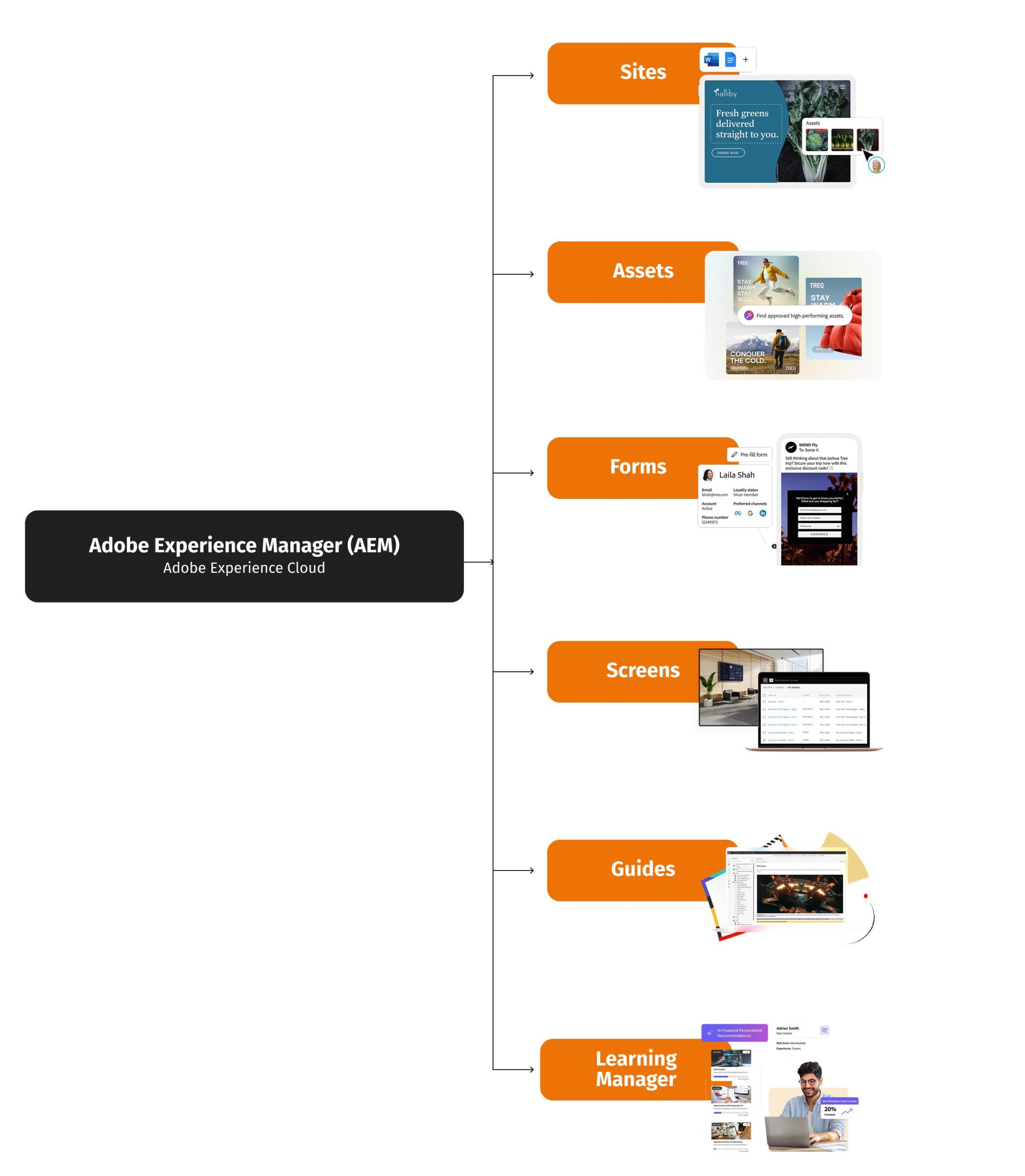
A suite, 6 solutions, one ecosystem.
Adobe Experience Manager is an enterprise digital platform that combines web content management and digital asset management in a unified, cloud-native system. It enables teams to create, manage and deliver consistent experiences across websites, mobile applications, physical channels and emerging interfaces.
At the core of AEM, you will find two main components: AEM Sites, the CMS, and AEM Assets, the DAM. Complementary solutions — AEM Forms, AEM Screens and AEM Guides — are available for more specific needs. The whole suite is natively connected to the Adobe Experience Cloud.
AEM as a Cloud Service is today the reference deployment model. It is a cloud-native infrastructure, with no version to maintain, updated continuously by Adobe. This is the architecture on which we support our clients.
The six building blocks of the AEM suite.
AEM Sites
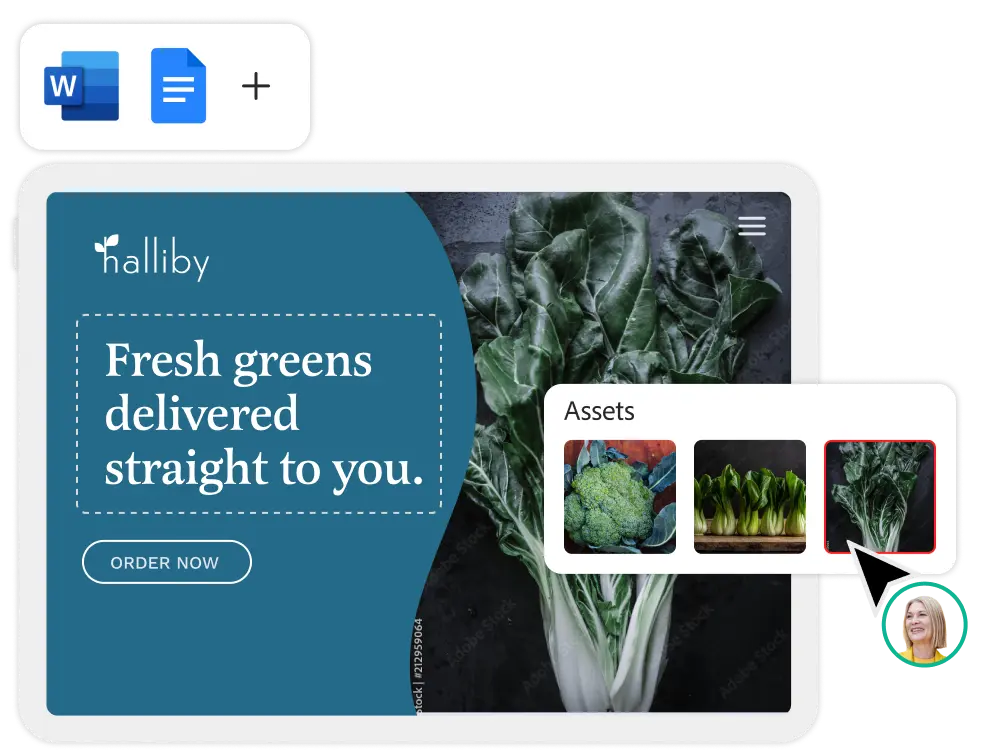
AEM Sites enables you to create, manage, optimise and deliver digital experiences across every channel. It is the tool that allows marketing teams to build pages without depending on development, while technical teams extend functionality with custom or low-code tools.
AEM Sites supports two complementary architectural approaches. In full-stack or hybrid mode, the tool manages both content and page rendering, with teams creating visual experiences directly in the interface. In headless mode, AEM becomes a decoupled CMS that exposes structured content via GraphQL or REST API, consumable by any front-end application — React, Angular, mobile app, IoT interface — independently of the presentation layer.
AEM Sites is one of the only scalable CMS platforms on the market with native capabilities to maximise performance: higher Core Web Vitals, Google Lighthouse scores close to 100, and pages optimised for both search engines and LLMs.
Your marketing teams publish content independently, your developers work with the technologies of their choice, and your pages perform without permanent manual optimisation.
AEM Assets
Digital asset management often starts with a simple problem: nobody knows where the latest version of a visual is. Files circulate by email, folders multiply, teams waste time looking for what should be there in two clicks.
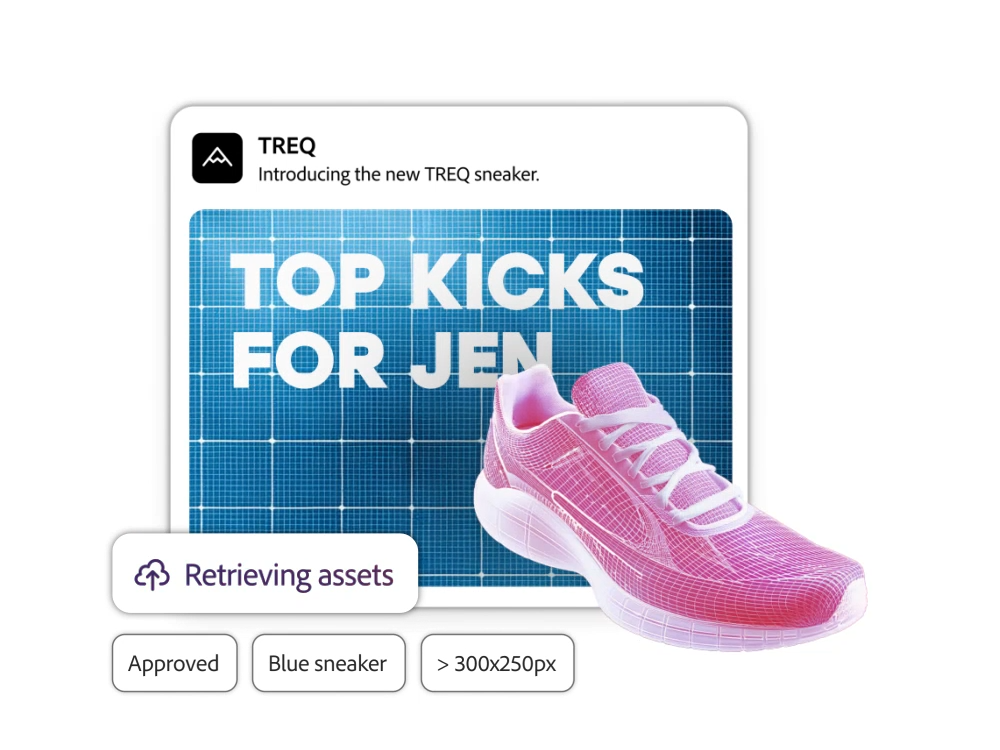
AEM Assets solves this at the root — a single, structured repository accessible to all teams. Adobe’s AI automatically tags assets at upload according to your business taxonomy. And thanks to native integration with Adobe Express and Adobe Firefly, teams create and adapt asset variations in line with the brand guidelines without raising a ticket to the creative team each time.
Dynamic Media
Dynamic Media is AEM Assets taken to its next level. The principle is simple: you upload a single source file, Dynamic Media handles the rest. The right format, the right resolution, the right quality — delivered in real time according to the device, screen size and user context. Desktop, mobile, tablet, social media — no need to create twenty variants by hand.
For e-commerce projects, the tool goes even further. Dynamic Media unlocks capabilities that transform the online product experience: 360° views, high-resolution zoom, adaptive video, interactive visuals. Experiences that hold attention and have a direct impact on conversion.
It is the building block we recommend as soon as a project involves a rich product catalogue, multiple distribution channels or performance requirements on media.
AEM Forms
AEM Forms enables the digitalisation and automation of high-stakes interactions involving registrations, files and the collection of sensitive data. It replaces manual and paper-based workflows with simplified, secure digital processes.
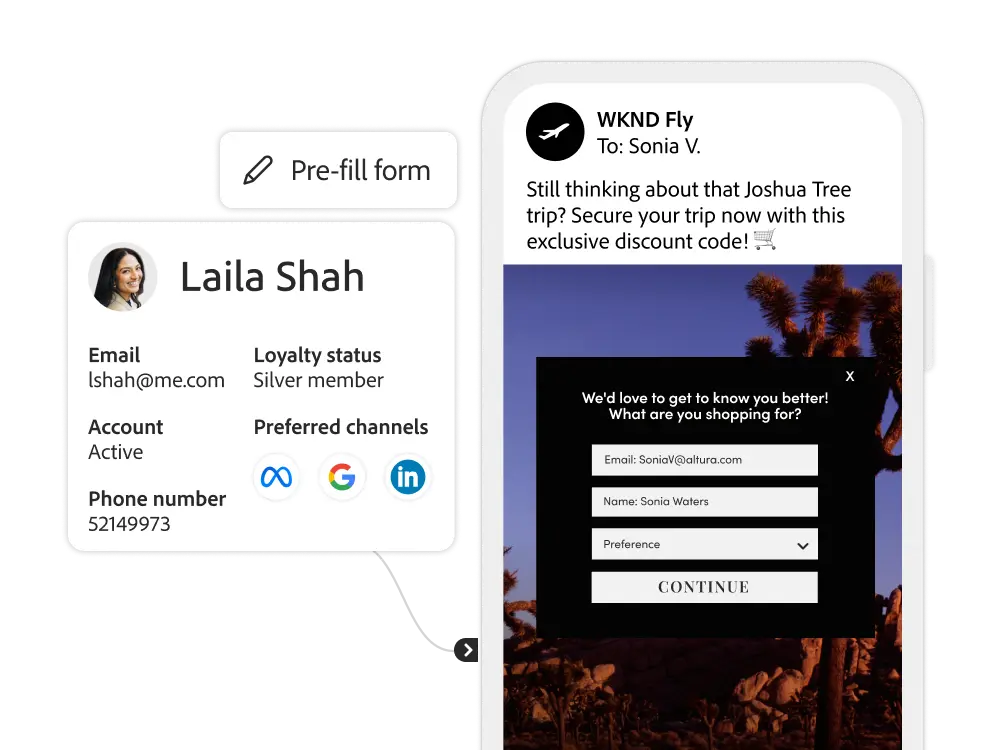
Adaptive forms that adjust to the user’s device and profile, electronic signatures, connection to backend systems to trigger automatic approval workflows — AEM Forms manages the secure assembly of documents, including support for digital signatures and accessibility standards.
Onboarding, registration and data collection processes move from paper to digital, without re-entry, with full traceability.
AEM Screens
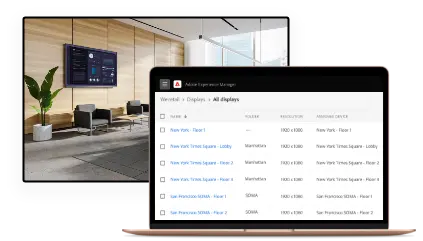
AEM Screens is a digital signage solution for managing content displayed in physical locations: points of sale, offices, reception areas. Content created in AEM Sites or AEM Assets can be broadcast on physical screens from the same platform, with the same governance.
AEM Guides
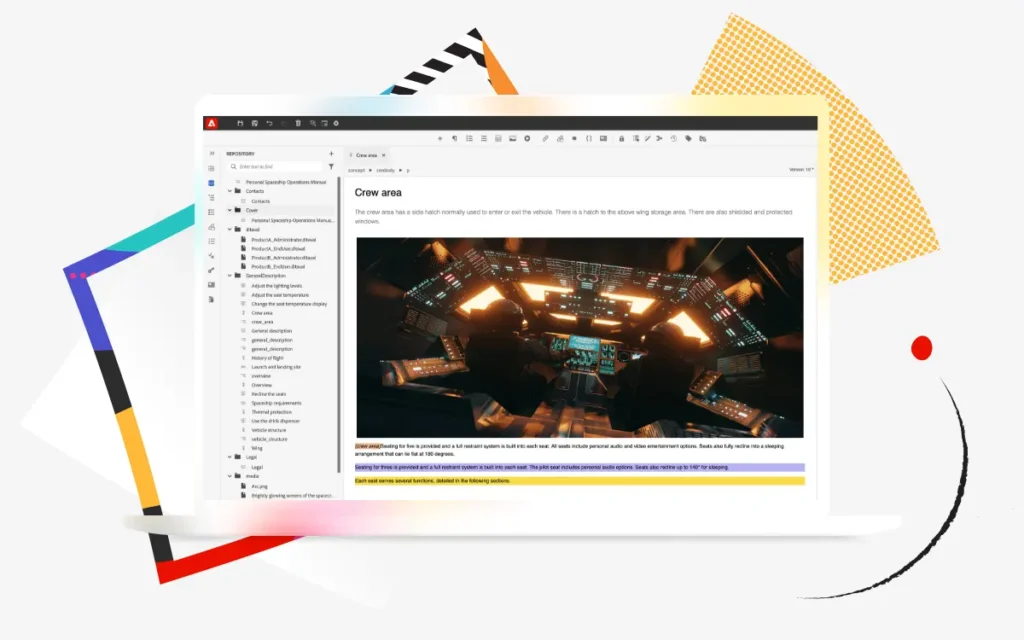
Product documentation, user manuals, knowledge bases, support content — these are significant volumes, often multilingual, that need to remain consistent across dozens of channels and be updated continuously. Without a dedicated tool, it quickly becomes an unmanageable project.
AEM Guides is Adobe’s cloud-native CCMS designed precisely for this. It is built on the DITA/XML standard, which allows content to be created once and published everywhere: website, PDF, mobile app, chatbot, CRM platform. One source, multiple destinations, without manual conversion or technical intervention at each publication.
Adobe Sensei AI accelerates the most time-consuming workflows: translation, version management, content reuse, consistency checking. And publication to AEM Sites is direct, without an intermediate step. For teams maintaining large-scale technical documentation, this means fewer back-and-forth exchanges, fewer errors and more autonomy.
Adobe Learning Manager
Training clients, resellers or employees on complex products does not happen by chance. Generic training fails to hold attention. Content scattered across multiple tools creates friction. And without tracking, it is impossible to know what is actually working.
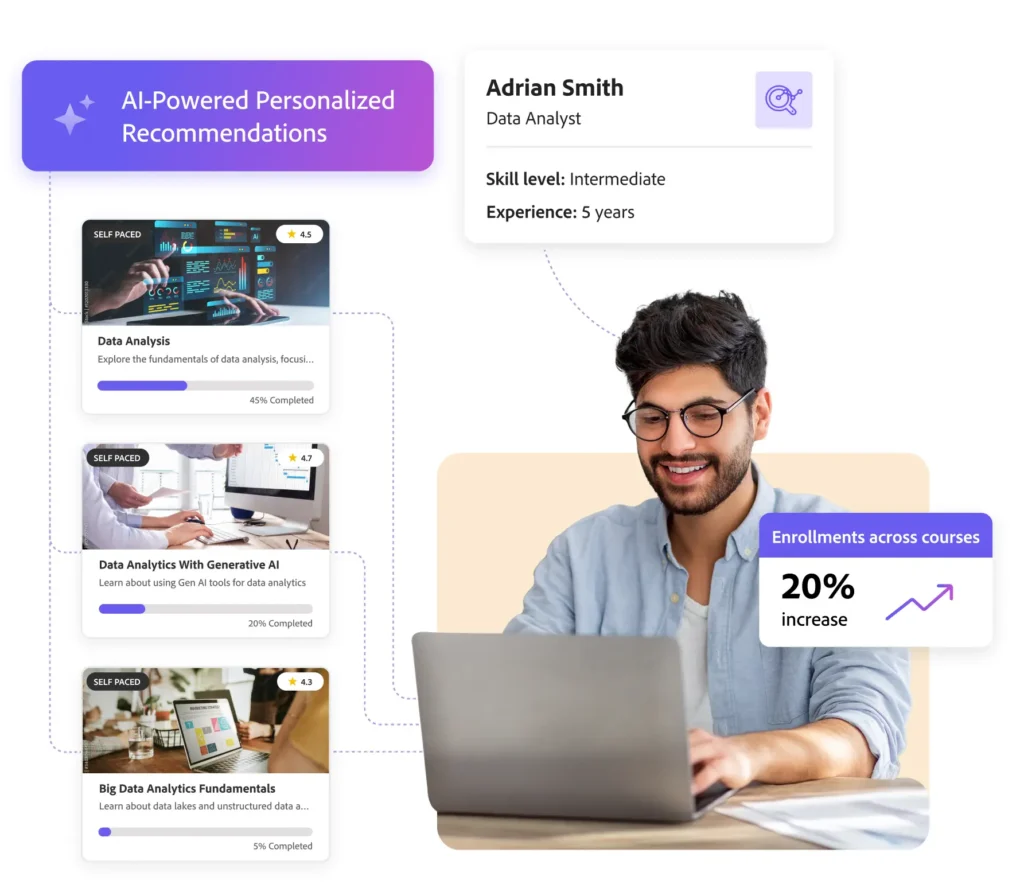
Adobe Learning Manager is Adobe’s LMS platform designed to create personalised learning experiences that reflect your brand. Whether you are training internal teams, onboarding resellers or supporting clients in getting to grips with your products, the platform centralises everything: content, learning paths, learner tracking and analytics.
Natively connected to the Adobe Experience Cloud, it integrates into a broader ecosystem of content, analytics and personalisation, for learning experiences that go well beyond standard e-learning.
AEM and artificial intelligence
Adobe has made agentic AI the central thread of its product roadmap since Adobe Summit 2025. The new capabilities of AEM include 10 dedicated agents covering site optimisation, content production, audience segmentation, journey orchestration and workflow automation. These agents operate autonomously within guardrails you define, learning from your content patterns and user behaviour to continuously improve results.
AEM Sites is also positioned to maximise visibility in search engines and LLMs by structuring content so that it is understood, cited and recommended by AI interfaces such as ChatGPT, Gemini or Perplexity. GEO (Generative Engine Optimisation) is now natively built into the platform.
AEM and Adobe Commerce.
This is where the question comes up most often: what is the difference between AEM and Adobe Commerce ? And do the two work together? They do not do the same thing — but they are designed to work together.
Adobe Commerce is the e-commerce platform. It manages the product catalogue, cart, checkout, pricing, promotions, logistics, and ERP and PIM integrations. It is the transactional engine.
AEM is the content and experience platform. It manages editorial pages, campaigns, digital assets, personalisation and forms. It is the editorial engine.
For an e-commerce project, the two can coexist depending on the chosen architecture. AEM can serve content pages — homepage, editorial category pages, lookbooks, brand pages — while Adobe Commerce manages the catalogue and transactions. The native integration between the two platforms, via the Adobe Commerce + AEM connector, allows product data to flow through AEM pages and enriches the e-commerce experience with personalised editorial content.
When should you consider AEM alongside Adobe Commerce? When your e-commerce site is no longer just a shop — when it has become a media, an acquisition tool, a brand platform that needs a powerful content editor just as much as a transactional engine.
01
Who is it for ?
AEM is an enterprise platform. It is designed for large organisations with the budget and internal resources to support it over time. It is not the right answer for a small-scale project — and we are completely transparent about that.
It is particularly suited to organisations managing multiple brands, multiple markets or multiple languages from a shared infrastructure. Those with large content teams who need autonomy without depending on development for every update. Those with significant volumes of digital assets to manage, adapt and distribute across multiple channels. And those already operating within the Adobe ecosystem — Analytics, Target, Campaign, Experience Platform — who want to connect everything together.
Large organisations
Multiple brands
Multiple markets
Multiple languages
Content teams
Need for autonomy
Large product catalogue
02
The best content management software.
Content is the engine of the digital experience. Managing it well is what makes the difference between good customer experiences and exceptional ones.
In 2026, G2 — the world’s largest software marketplace with over 100 million annual buyers — awarded Adobe Experience Manager the title of best Content Management Software as part of its Best Software Awards. A recognition based exclusively on reviews from real users, not editorial criteria. AEM was also distinguished among the Best Enterprise Products alongside Adobe Analytics and Adobe Customer Journey Analytics — a double recognition that confirms its position as the reference platform for organisations managing content at scale, across multiple channels, regions and brands.

portfolio
We treat the projects of all our clients with the same care and expertise to bring them a unique and high-quality digital solution.















Our positioning on AEM is a natural one: we are an Adobe agency, specialised in the Adobe Commerce ecosystem. AEM is the logical complement for projects where the content experience needs to match the e-commerce experience.
We work on AEM Sites projects in headless or hybrid architecture, on AEM + Adobe Commerce integrations, and on AEM Assets projects for organisations that need to structure their digital asset management.
Do you have an AEM project or a question about AEM + Adobe Commerce integration?