

Artificial intelligence.
AI is changing e-commerce. And we’re here to help you get the most out of it.
Our conviction.
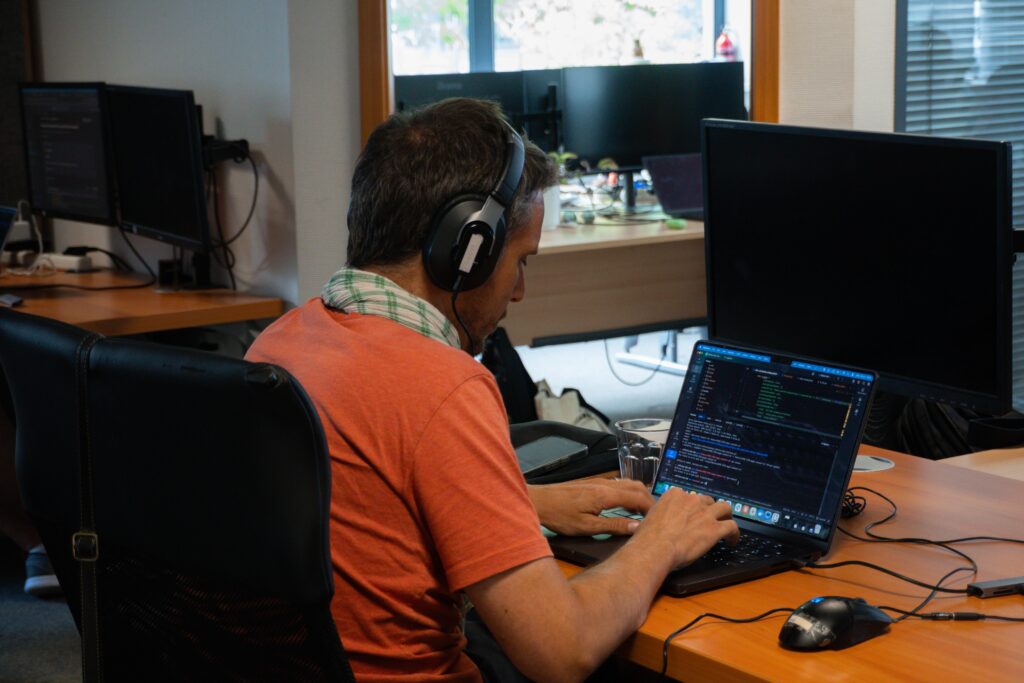
We didn’t wait for AI to become unavoidable before adopting it. We have been using it in production since 2023 — in our development workflows, in the way we produce content, in our approach to architecture. AI concretely transforms the way an e-commerce platform is built and evolved: in product recommendations, in search, in catalogue content generation, and in process automation. And now, in the way your products are found and purchased directly via AI interfaces.

Our AI services
AI Audit.
Before investing, you need to understand. Where do you stand in terms of AI maturity? What are your priority use cases? What gains can you expect, and over what timeframe? A structured audit to identify the most profitable levers, prioritise workstreams and build a realistic roadmap. We don’t produce an 80-page report. We offer a working session with your technical and business teams, followed by a list of actions ranked by impact and effort — so you leave with an actionable plan.
AI integration into your e-commerce projects.
AI doesn’t get bolted on — it gets integrated. On Adobe Commerce and Magento Open Source, AI creates value when it is built into the architecture from the start, not added as an afterthought. Personalised product recommendations, intelligent search, conversational agents connected to your stock and prices, catalogue content generation, customer segment personalisation — integrations start from concrete use cases.
Automated testing with the QA team.
Our QA team is trained in using AI for the generation and execution of automated tests. Claude generates test scenarios from functional specifications, identifies edge cases, and produces test scripts. What used to take several days of manual writing now takes a few hours — with more exhaustive coverage and tests that are maintainable over time.
Agentic commerce.
At the end of 2025, e-commerce traffic from AI sources grew by more than 600% in a single year. ChatGPT, Gemini and Perplexity recommend products, and agents are beginning to place orders on behalf of their users. Are your products visible where your customers are searching now? Search is evolving. We help you position your products to be found, cited and recommended by LLMs: data structure, product page semantics, compatibility with the emerging ACP and UCP protocols. Structuring your data, enriching the semantics of your product pages and anticipating how LLMs consume your content — this is SEO applied to new search interfaces.
Training your teams.
AI is only useful if your teams know how to use it. We train your developers, project managers, content and marketing teams in the practical use of AI in their day-to-day work. We offer real use cases, calibrated to your tools and your sector, led by practitioners who use it in production every day. Training is available in person or remotely, within two weeks, and can be funded via OPCO, France Travail or your Region.
Our 3-step approach.
We don’t sell AI for the sake of selling AI. We start from where you are — your tools, your teams, your challenges — and identify the most concrete levers before touching anything.
- Understand: Audit, use case identification, prioritisation. What already exists in your stack? Where can AI integrate without rebuilding everything? What return can you expect, and in how long? We don’t start with the technology — we start with your questions.
- Experiment: Prototype, POC, testing on a limited scope. Before scaling, we validate. A product recommendation that performs on 10% of the catalogue is proof. A conversational agent tested on a customer segment is an informed decision.
- Deploy: Production integration, documentation, team training, performance monitoring. AI in production is a workstream that requires ongoing care. That’s why we stay by your side after go-live, to ensure optimal performance over the long term.
An appropriate legal framework.
Bringing AI into an e-commerce platform means handling customer data. Personalised recommendations, conversational agents, behavioural segmentation: every use case carries concrete GDPR implications. And since 2 August 2026, the EU AI Act adds obligations of its own.
We’re not a law firm. But we design integrations that won’t put your compliance at risk, and we work with your legal team or DPO rather than around them.
On every project, that means:
- GDPR. We map which data flows to the models and document the legal basis for each processing activity. Then we apply data minimisation: a recommendation engine doesn’t need your customers’ identity to work. European hosting, processor agreements in place, and no customer data used to train third-party models.
- Transparency. Since 2 August 2026, Article 50 of the AI Act requires you to tell users they’re interacting with an AI and to flag AI-generated content. Our conversational agents and generated catalogue content meet that requirement by design, not as an afterthought.
- Automated decisions. Dynamic pricing, order refusals, customer scoring: the moment an algorithm decides on its own, Article 22 GDPR applies. We keep a human in the loop and keep decisions traceable.
- Team readiness. Article 4 of the AI Act has required AI literacy training for your staff since February 2025. It’s also what prevents data leaks through unsupervised use. Our training covers both.
Worth knowing: the heaviest obligations, those targeting so-called “high-risk” systems, were pushed back to December 2027 by the Digital Omnibus. And most e-commerce use cases (search, recommendation, content generation) don’t fall into that category anyway. Our job is to help you qualify your use cases, not sell you compliance you don’t need.
Why ATI4.
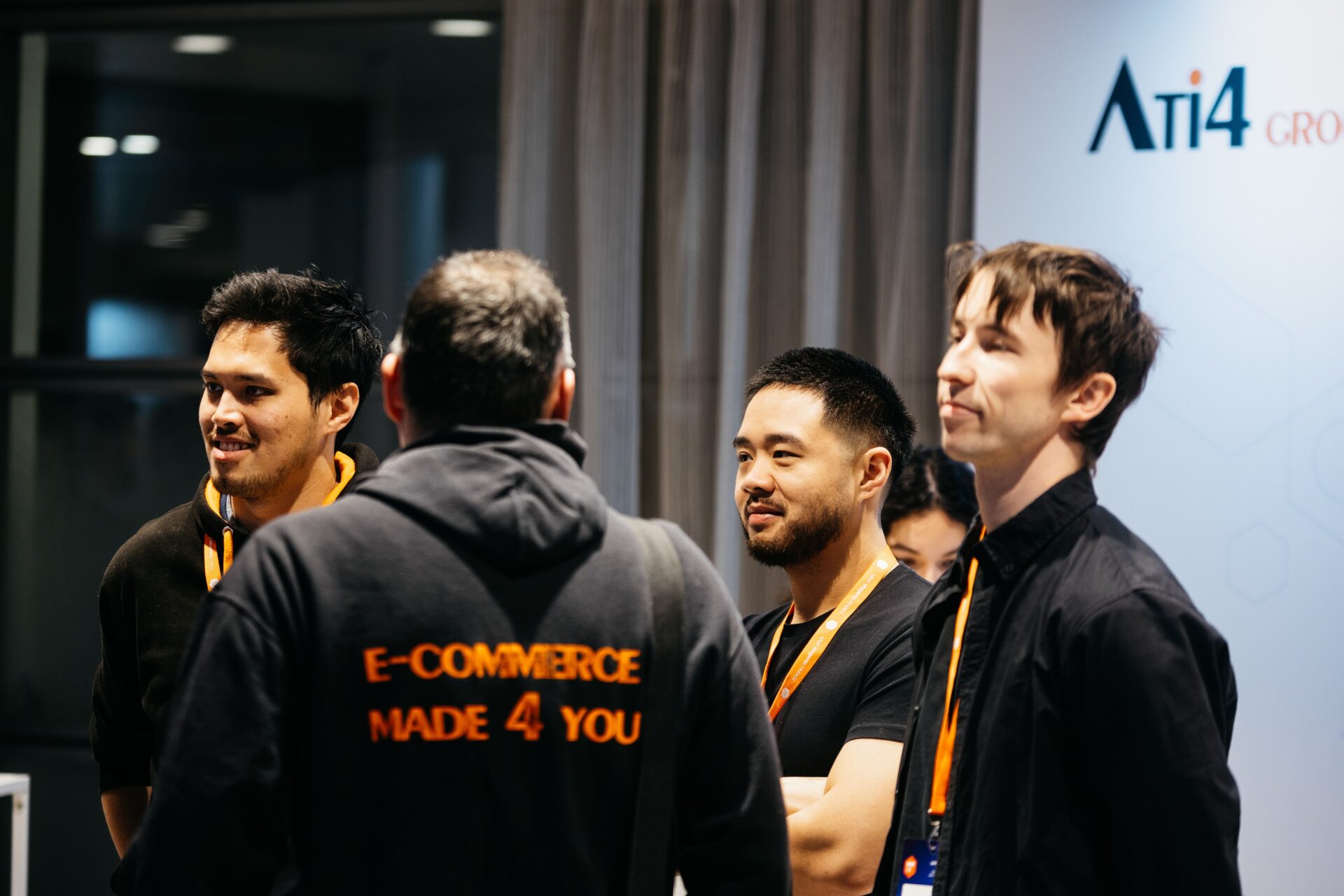
We are an Adobe Commerce and Magento specialist e-commerce agency that has been using AI in production since 2023 — on our own projects, before recommending it to our clients. The difference is concrete. The AI we integrate sits within a platform we know inside out: architecture, product data, ERP and PIM integrations, front-end performance. We don’t deploy generic tools on projects we don’t understand. We integrate the right tools in the right place — because we know where the right place is.
Our teams continuously train on the latest ecosystem developments, and we have made Claude our primary tool. We experiment internally before recommending externally. And when your team needs to upskill, we can train them — with the same people who work on your projects.
Want to integrate AI into your e-commerce project ?
Our team is available to discuss it !